I am utterly crap at bargaining, a fact which was first brought to my attention when I went to Bali some years ago. It isn't so surprising when you remember I don't like confrontation, and although bargaining might be friendly it is still a form of confrontation. I have a lot of trouble standing my ground when a) I really like & want the item, b) I'm not sure whether I'm in the right to demand the price I'd like, and c) the salesperson/store owner is trying to wear me down with persuasiveness and aggressive sales tactics.
In fact, I have issues with sales people, period. I know it is a problem but I really feel bad saying no to them... although I know, intellectually, that they are trained and prepared for the fact that someone might say no. I even feel bad when I try on clothes and nothing fits or looks nice, and then have to tell the saleslady that I don't want any of the 5 items I brought into the dressing room with me!
Imagine how much worse it is when the salesperson is pushy and aggressive and, well, you get the picture...
Anyway. So in all this shopping for furniture, I, um... just happened to invent an imaginary husband. The first time the salesperson kept pressing me to make a decision on the spot, I blurted out, "I have to consult my husband first," and it's been a very useful way of escaping whenever they get a bit too aggressive for me to handle. I wonder what the future hubby, whoever he is, will think of this when he finds out! I feel like a bit of a coward :-\
Tuesday, July 19, 2011


Sunday, July 17, 2011
The reasoning
I never did explain why I want a chaise lounge so much: it's going to be the place where I curl up to read, my personal hangout spot (not that the whole apartment wouldn't be that, but this will be special, you see?). I've never had that in any place I've ever stayed. Most of the time I lie in bed to read, but it's not really the most comfortable position -- and not good for the eyes, or so they say. So I'm going to have a spot where I can lounge in comfort and read, with a reading lamp peeking over my shoulder to illuminate the words on the page.
I was inspired by a picture in a book, which I surreptitiously took a photo of using my iPod Touch, and forgot to note the name of the book itself. Things like that irk me, they make me feel that my blog post is not complete. "Attribution! Attribution!" my inner OCD journalist-cum-academic yells at me. Blimey!

No one is going to spend as much time in the apartment as I am, and frankly, I don't really expect many visitors, being as that it's on the 5th floor and there's no lift ;) So I figure I shall furnish the place for myself, and if that means a chaise lounge instead of a sofa (because there probably isn't room for both), then so be it.
I'm also considering a small aquarium, to have something that's alive around me. Why fish? Easy to care for, although you can't really have a relationship with them like you can with a dog; but practical for an apartment, and I figure I can choose pretty fish which will double up as decor and make me feel happy when I see them. But in a strange way, even though they're just going to be swimming around in their tank, they'll be a reason for me to go home, and I think will make me feel like I'm not going back to an empty apartment where there's nobody to care whether I'm there or not.
Or maybe I'll get a hamster. Just because they're cute :p

Image from feathersfinsandfur.com
I was inspired by a picture in a book, which I surreptitiously took a photo of using my iPod Touch, and forgot to note the name of the book itself. Things like that irk me, they make me feel that my blog post is not complete. "Attribution! Attribution!" my inner OCD journalist-cum-academic yells at me. Blimey!

No one is going to spend as much time in the apartment as I am, and frankly, I don't really expect many visitors, being as that it's on the 5th floor and there's no lift ;) So I figure I shall furnish the place for myself, and if that means a chaise lounge instead of a sofa (because there probably isn't room for both), then so be it.
I'm also considering a small aquarium, to have something that's alive around me. Why fish? Easy to care for, although you can't really have a relationship with them like you can with a dog; but practical for an apartment, and I figure I can choose pretty fish which will double up as decor and make me feel happy when I see them. But in a strange way, even though they're just going to be swimming around in their tank, they'll be a reason for me to go home, and I think will make me feel like I'm not going back to an empty apartment where there's nobody to care whether I'm there or not.
Or maybe I'll get a hamster. Just because they're cute :p

Friday, July 15, 2011
Long live practicality
I spent some time looking at interior design books in MPH a few weeks ago, and it was dangerous, because -- ah, me! -- how would a normal person like me ever able to afford a house and furniture like that? But more, I doubt I'm ever going to be the kind of person to have a picture-perfect home like that, because for one thing, um... well. My home would probably look more "lived in" than "showcase" :p
There is a lot more of my parents in me than I ever realised, which I discovered when I visited IKEA recently. There are a lot of pretty things which are simply impractical and would gather too much dust: take this Fillsta ceiling lamp, for example.

Image from IKEA.com
So I found myself walking around and thinking, "Oooh, interesting design, pity about the dust... so pretty, but ugh, dust... that one, hmm, dust..."
It's a bit scary, come to think of it.
At 33 I guess practicality has begun to win out over aesthetics, and even over vanity(!). So although open bookshelves have more character, I'd rather have glass doors to keep the dust out; and knickknacks, well, I can hear my mom's voice in my head saying, "They just sit there and gather dust." I like having little touches and decorative items here and there, but I know I'm not the type to dust every week... If I were rich, I suppose I'd compromise and hire a maid to do the dusting for me!
Growing up does suck sometimes :p
It's easy to tell yourself you'll only buy things you really like for the home. Then you find out that the glass-topped dining table you really like costs RM1,250, and the 5ft x 5ft L-shaped study desk won't fit in your room no matter which way you try to position it. But never mind, I shall have my CHAISE LOUNGE and my BEANBAGS. Take that, life! Nyah nyah nyah!!!
There is a lot more of my parents in me than I ever realised, which I discovered when I visited IKEA recently. There are a lot of pretty things which are simply impractical and would gather too much dust: take this Fillsta ceiling lamp, for example.
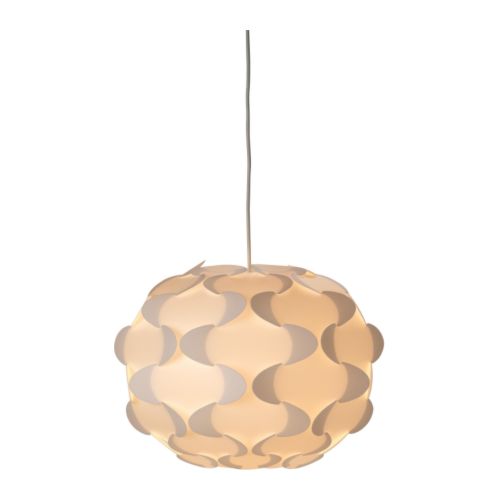
So I found myself walking around and thinking, "Oooh, interesting design, pity about the dust... so pretty, but ugh, dust... that one, hmm, dust..."
It's a bit scary, come to think of it.
At 33 I guess practicality has begun to win out over aesthetics, and even over vanity(!). So although open bookshelves have more character, I'd rather have glass doors to keep the dust out; and knickknacks, well, I can hear my mom's voice in my head saying, "They just sit there and gather dust." I like having little touches and decorative items here and there, but I know I'm not the type to dust every week... If I were rich, I suppose I'd compromise and hire a maid to do the dusting for me!
Growing up does suck sometimes :p
It's easy to tell yourself you'll only buy things you really like for the home. Then you find out that the glass-topped dining table you really like costs RM1,250, and the 5ft x 5ft L-shaped study desk won't fit in your room no matter which way you try to position it. But never mind, I shall have my CHAISE LOUNGE and my BEANBAGS. Take that, life! Nyah nyah nyah!!!
Wednesday, July 13, 2011
On Sunflower's mind
A chance link to a friend's blog (which I didn't know she had) made me want to write again. Writing from the heart, that holds the voice of a person, always inspires me to write. It reminds me what it's like to connect with others through the written word.
The main thing on my mind these days is furniture and decorating. I just bought an apartment. Haven't moved in yet, and already I'm wishing I had more space. Although my colleague who recently moved back from Hong Kong tells me that 850 square feet is loads of space!
I've never had my own place before, and it's funny how my mentality changed once I knew that this was going to be mine. Before, I didn't care about cutlery and dinnerware, as long as I had plates and cups and forks and spoons to use. Now I'm dreaming about having matched sets, pretty things that will make me feel happy when I use them in my new home. It's really weird.
From "I won't do any major renovations", I'm now contemplating putting in built-in bookshelves for all my books. But well! I do have a lot of books, I argue with myself, and it would be nice if I could have them all back here, in my own home, instead of sitting in boxes in my brother's storeroom. The only thing I worry about is having uncles and aunts come over and then ask me how much those bookshelves cost. You don't know my family. It's going to be all, "Why did you spend so much money on something unnecessary?" (In my family, unless you'll die without it, it's considered unnecessary. And therefore expendable.)
But you can never have perfection, and so instead of the lovely natural wooden colour I'd love to have for my bookshelves, like so:

Image from kitchencabinetmart.com
-- instead of this colour, I've decided to opt for white, simply because white will make the room look larger; this kind of colour is too dark for a small room. It's a compromise I'm making out of necessity. In general, white is my least favourite colour, because it gets dirty so easily, is difficult to maintain (especially on clothing) and is so stark. It has no personality.
I'm also having to think about my style, what kind of style I want my home to have, especially in the living room. I've always known I'm not a minimalistic type. The very thought would make any of my friends laugh their heads off! Super modern steel and glass stuff is not me either; that's too sterile and soulless for me. Antiques are too stiff and usually rather uncomfortable. I want furniture that will be so comfortable to sit on, I could plonk myself down on the couch and fall asleep. Welcoming furniture, you know. Homey furniture. Like bean bags.
Although I also want a chaise lounge. I saw something like this and have been dreaming of it ever since:

Image from siamoldteak.com
It was very comfortable! I'm told it wouldn't "go" with bean bags but I don't care :p
The main thing on my mind these days is furniture and decorating. I just bought an apartment. Haven't moved in yet, and already I'm wishing I had more space. Although my colleague who recently moved back from Hong Kong tells me that 850 square feet is loads of space!
I've never had my own place before, and it's funny how my mentality changed once I knew that this was going to be mine. Before, I didn't care about cutlery and dinnerware, as long as I had plates and cups and forks and spoons to use. Now I'm dreaming about having matched sets, pretty things that will make me feel happy when I use them in my new home. It's really weird.
From "I won't do any major renovations", I'm now contemplating putting in built-in bookshelves for all my books. But well! I do have a lot of books, I argue with myself, and it would be nice if I could have them all back here, in my own home, instead of sitting in boxes in my brother's storeroom. The only thing I worry about is having uncles and aunts come over and then ask me how much those bookshelves cost. You don't know my family. It's going to be all, "Why did you spend so much money on something unnecessary?" (In my family, unless you'll die without it, it's considered unnecessary. And therefore expendable.)
But you can never have perfection, and so instead of the lovely natural wooden colour I'd love to have for my bookshelves, like so:

-- instead of this colour, I've decided to opt for white, simply because white will make the room look larger; this kind of colour is too dark for a small room. It's a compromise I'm making out of necessity. In general, white is my least favourite colour, because it gets dirty so easily, is difficult to maintain (especially on clothing) and is so stark. It has no personality.
I'm also having to think about my style, what kind of style I want my home to have, especially in the living room. I've always known I'm not a minimalistic type. The very thought would make any of my friends laugh their heads off! Super modern steel and glass stuff is not me either; that's too sterile and soulless for me. Antiques are too stiff and usually rather uncomfortable. I want furniture that will be so comfortable to sit on, I could plonk myself down on the couch and fall asleep. Welcoming furniture, you know. Homey furniture. Like bean bags.
Although I also want a chaise lounge. I saw something like this and have been dreaming of it ever since:

It was very comfortable! I'm told it wouldn't "go" with bean bags but I don't care :p
Sunday, November 7, 2010
Live for the now
Picked up a copy of the New Straits Times last night at the mamak as I was waiting for my dinner to be ready. I hadn't brought my phone so couldn't play sudoku to amuse myself as I normally do... and the TV was showing football, pah.
It's been awhile since I last read the physical version of the paper. All doom and gloom -- floods, bus accidents, plane crashes, volcano eruptions -- makes me wonder how anyone would ever dare to go out of the house after reading it. There was an article about an inter-state express bus crash that claimed a life. I was reminded of all the times I'd taken the Sri Maju bus back home (a 4-hour journey), or from home back to KL. Makes me feel lucky to be alive.
And then there's the news about the volcano erupting in Java, Indonesia. I've always wondered about people who live in areas where there are active volcanoes, earthquake fault lines, or in paths of hurricanes -- why do they do that? When they know there's a chance of this... this thing they can't control doing irreparable damage, upending their lives? I remember feeling flabbergasted after reading in National Geographic that people in New Orleans were going right back and rebuilding after Hurricane Katrina. Me, I would have tried to start over somewhere new, I think. Why stay when there's the chance that it might happen again?
It seems to me that most things are random. I'm a Christian so I believe that there is a plan, but still, since I don't know the plan everything appears random. Between the things that are random and the things that are somewhat predictable (like the fact that if you live on a fault line you're probably going to experience an earthquake sooner or later), I'd like to eliminate the predictable ones. The random ones we all have to live with; you just have to be careful and prepare the best you can.
So sometimes I think about the fact that I might die tomorrow, get hit by a bus on the way to work or something. I mean, you never know, right? I think about the fact that this might be the last time I'm seeing my brother because something could happen to him as he makes his way home to Seremban. It brings home to me the idea that life is short and unpredictable, and we ought to make the most of it because we simply do not know how long we have. We don't know how much time we'll be granted with those we love, and we don't know how much time we'll have on this earth.
The person who died in the bus crash I mentioned above was a 25-year-old man, engaged to be married. The wedding was to have taken place next year. I can't even imagine what it is like to have someone ripped away from you like that, when you have been making plans together. All of a sudden the life you envisioned will never be, and you have to readjust all your hopes and expectations for the future. Sometimes I look at long-time couples and think they are a little complacent, although of course it's not my place to judge. But they hold off on making a firmer commitment to each other (read: marriage) because they want to establish their careers first, they want to buy a house, they want to save up for the perfect wedding... they think they have a lot of time, but how do they know? We simply don't know.
Oh, I'm not advocating that we should rush into anything. But you know, when you are pretty sure that you've found the one for you... what are you waiting for? In any case, since life is unpredictable, the most important thing is to cherish those you love. Too many people have regrets after losing a loved one, or when they themselves are lying on their deathbed. Say the things that need to be said. Do the things that need to be done. I've started telling my parents that I love them -- we Asians are notorious for being lousy at verbal expressions of love, especially my parents' generation and the generation before them. But, I want them to know, even if I'm often not the perfect daughter and I make decisions that are incomprehensible to them, that I do love them.
Saturday, November 6, 2010
Hanyalah nasib (It's just luck)
A lot of things are said about social media and connectedness. Yesterday, after the Judith Griggs story broke all over the place, Noel Cody wrote, "It's surprising that, in our connected world, Griggs believed she could act the way she did and get away with it."
I'm not surprised, though. I've been blogging since mid-2002 and in the course of my, uh, blogging life, I've written about loads of things that have happened to me. So have many of my blogging friends. Yes, we get supportive, sympathetic and encouraging comments, but never has anything like this happened to any of us. No one took up our cause or got fired up enough on our behalf to offer more than the ordinary levels of help and support.
The fact is, when something like this happens we realise how very connected we all are, and how the Internet connects us; but it is a very rare thing, or at least, rarer than we realise. Whether or not an incident gets spread all over blogs, Facebook, Twitter and international news sites is often a matter of luck. In Griggs' case, I'm pretty sure she'd consider it bad luck.
One of the most important things here was Monica Gaudio's (the original blogger) friendship with Nick Mamatas on LiveJournal and Nick's posting, then tweeting about what had happened. He's an author, and writers tend to know each other -- it's a small community; the same goes with journalists, lawyers, and so on. So fellow writer John Scalzi read Nick's post and felt strongly enough to blog about it. He also tweeted a link to Monica's post. His tweet was then picked up and retweeted by Neil Gaiman, a very well-known author. This was the second important thing: like I said yesterday, Gaiman has 1,500,998 followers on Twitter, so his tweet was probably highly influential in setting off the Internet storm.
Looking at the chain of events, they might not have been entirely unpredictable but you couldn't say they were probable, either. In fact if Monica had not known Nick Mamatas, or Nick hadn't felt strongly enough to blog and tweet about it, none of the rest of this might have happened.
A few months ago, over here in Kuala Lumpur, a person posted a Facebook note about two petrol station attendants who had refused to lend him the station's fire extinguisher to help put out a fire in a nearby traffic accident. As a result, the accident victim, who had been trapped in her car, burnt to death. The story was blogged and retweeted by many, and picked up by at least two local online papers. When the story broke, the company responded by saying that the station attendants had refused to open the door or lend the extinguisher to the man "as he was not acting calmly when asking for assistance", which is a bit ridiculous -- the matter was urgent and it had been an emergency, how could they expect him to be calm?
There was some outpouring of anger and indignation against the petrol company in question. Some people called for a boycott of all the stations owned by that company. Yet all in all it was nothing like what Griggs experienced. The vilification only took place in small pockets among local Internet users. Life went on as usual for all the rest. And, ultimately, nothing changed. It became a sort of storm in a teacup, despite the loss of a life.
The point is, although there's always the possibility of someone voicing out their displeasure on the Internet, and this getting picked up by big name bloggers or international news sources, most people who act like asshats tend to think, "It'll never happen to me." That's a very human thing. It's also true that most of the time it doesn't, or won't happen. I do believe in "the power of the Internet" but I also believe in being realistic.
Somewhat related reading:
Small Change: Why the Revolution Will Not be Tweeted (New Yorker)
Friday, November 5, 2010
The tale of Judith Griggs
I find loads of interesting things on Twitter, which is mostly why I use it these days. This morning I read about a magazine editor lifting a blogger's post and printing it in the magazine without first notifying or asking for permission. The magazine attributed the article to the writer in question, so imagine her surprise when her friend congratulated her on getting published!
She contacted the magazine, and when asked what she wanted them to do about it, she asked for "an apology on Facebook, a printed apology in the magazine and $130 donation (which turns out to be about $0.10 per word of the original article) to be given to the Columbia School of Journalism". Why Facebook? Because the magazine's pages are uploaded to its Facebook page, each issue being granted its own photo album.
Well, not only did they refuse to apologise, the editor of the magazine wrote an email that said:
It's the sort of thing that proves truth is stranger than fiction.
Unfortunately for the magazine editor, Judith Griggs, the writer blogged about all of this. Even more unfortunately for her, that post was picked up by Twitter and Facebook users, even retweeted by Neil Gaiman (who has 1,500,998 followers). Eventually big names like Boing Boing, Salon.com, The New York Times, and The Guardian, to mention a few, picked up on it too. Thus what must have seemed like the whole Internet community descended on her magazine's Facebook page, "liked" it and proceeded to, uh, vilify her business practices via wall postings.
Not only that, people began to investigate further, discovering that her magazine had also lifted content from other places, among them more prominent names like Martha Stewart and the Australian chapter of Weight Watchers; these people/organisations were informed of the discovery, as were the magazine's advertisers. Five writers/organisations have confirmed their work was reproduced without permission, with some contemplating legal action. A number of advertisers have also withdrawn their ads from the magazine.
It turns out that the magazine is mainly distributed locally and most of the advertisers are local businesses. While everyone is busy wondering how Griggs could be so misguided as to believe that anything published on the Internet is public domain (it is not, in case you were wondering), I'm just wondering what ramifications all this will have for Griggs.
I mean, how is she going to continue living where she's living? Local business owners and their employees will probably be giving her the cold shoulder after this; a (now former) advertiser commented, "...being associated with publications like this that don't respect its readers (who are all our potential customers) is unacceptable to us in light of their practices. What angers me even more is the fact that it is being made light if [sic] by the Editor herself." Apart from that, I expect the local townspeople will be pointing and whispering behind her back, and I'm also wondering what her employers will think about her notoriety, since editing the magazine wasn't her day job. I really can't imagine how she's going to hold her head up or dare to go out in public.
Yet she posted on her magazine's Facebook page:
It really does seem like she doesn't get it at all. In my part of the world, we call this Being unclear of the concept.
She contacted the magazine, and when asked what she wanted them to do about it, she asked for "an apology on Facebook, a printed apology in the magazine and $130 donation (which turns out to be about $0.10 per word of the original article) to be given to the Columbia School of Journalism". Why Facebook? Because the magazine's pages are uploaded to its Facebook page, each issue being granted its own photo album.
Well, not only did they refuse to apologise, the editor of the magazine wrote an email that said:
- I've been an editor for 3 decades and I know about copyright laws
- I haven't done anything wrong because everything on the Internet is public domain
- You should be thankful that we actually credited you as the writer
- Your article was badly written and our editing made it better, so you should be paying us.
It's the sort of thing that proves truth is stranger than fiction.
Unfortunately for the magazine editor, Judith Griggs, the writer blogged about all of this. Even more unfortunately for her, that post was picked up by Twitter and Facebook users, even retweeted by Neil Gaiman (who has 1,500,998 followers). Eventually big names like Boing Boing, Salon.com, The New York Times, and The Guardian, to mention a few, picked up on it too. Thus what must have seemed like the whole Internet community descended on her magazine's Facebook page, "liked" it and proceeded to, uh, vilify her business practices via wall postings.
Not only that, people began to investigate further, discovering that her magazine had also lifted content from other places, among them more prominent names like Martha Stewart and the Australian chapter of Weight Watchers; these people/organisations were informed of the discovery, as were the magazine's advertisers. Five writers/organisations have confirmed their work was reproduced without permission, with some contemplating legal action. A number of advertisers have also withdrawn their ads from the magazine.
It turns out that the magazine is mainly distributed locally and most of the advertisers are local businesses. While everyone is busy wondering how Griggs could be so misguided as to believe that anything published on the Internet is public domain (it is not, in case you were wondering), I'm just wondering what ramifications all this will have for Griggs.
I mean, how is she going to continue living where she's living? Local business owners and their employees will probably be giving her the cold shoulder after this; a (now former) advertiser commented, "...being associated with publications like this that don't respect its readers (who are all our potential customers) is unacceptable to us in light of their practices. What angers me even more is the fact that it is being made light if [sic] by the Editor herself." Apart from that, I expect the local townspeople will be pointing and whispering behind her back, and I'm also wondering what her employers will think about her notoriety, since editing the magazine wasn't her day job. I really can't imagine how she's going to hold her head up or dare to go out in public.
Yet she posted on her magazine's Facebook page:
- Hi Folks!
Well, here I am with egg on my face! I did apologise to Monica via email, but aparently it wasnt enough for her. To all of you, thank you for your interest in Cooks Source and Again, to Monica, I am sorry -- my bad!
You did find a way to get your "pound of flesh..." we used to have 110 "friends," we now have 1,870... wow!
...Best to all, Judith
It really does seem like she doesn't get it at all. In my part of the world, we call this Being unclear of the concept.
Subscribe to:
Posts (Atom)